

Starting TMS can be a big step. We make the process simple, supportive, and transparent — so you always know what to expect.
Your Patient Journey
A CLEAR PATH FORWARDStart the Conversation
Reach out to our team to learn more about TMS and tell us a little about what you've been experiencing. We'll answer your initial questions and gather the information needed to get started.
- Tell us about your symptoms and goals
- Provide basic contact and insurance information
- We'll let you know if a referral is required
We Verify Your Insurance Benefits
Our team reviews your insurance coverage for TMS and determines whether your plan has any specific requirements. We'll explain what we learn and guide you through the next steps.
- Checking your TMS benefits
- Explaining coverage requirements
- Identifying any needed documentation
Meet With Dr. Stone
You'll meet with Dr. Sarah Stone, a board-certified psychiatrist, for a comprehensive evaluation to determine whether TMS is appropriate and safe for you.
- Your symptoms and diagnosis
- Previous medications and treatments
- Relevant medical and neurological history
- Your goals, questions and preferences
Insurance Authorization, If Required
If your insurance plan requires prior authorization, Anew TMS will submit the necessary documentation and keep you informed throughout the process.
- We submit required documentation
- We communicate with your insurance plan
- We contact you when authorization is complete
Your First Treatment Visit
Dr. Stone performs motor threshold mapping to determine the appropriate location and intensity of stimulation for you. Your treatment settings are personalized before treatment begins.
- Personalized motor threshold mapping
- Your individual treatment settings are established
- You'll have time to ask questions
- You remain awake throughout the process
Begin Regular TMS Sessions
You'll return to Anew TMS for regularly scheduled treatments over several weeks. Treatment is outpatient, noninvasive and designed to fit into your normal routine.
- Typical treatments are about 3 minutes
- No anesthesia or sedation
- No recovery period or downtime
- Return to your normal activities afterward
Support Between Sessions
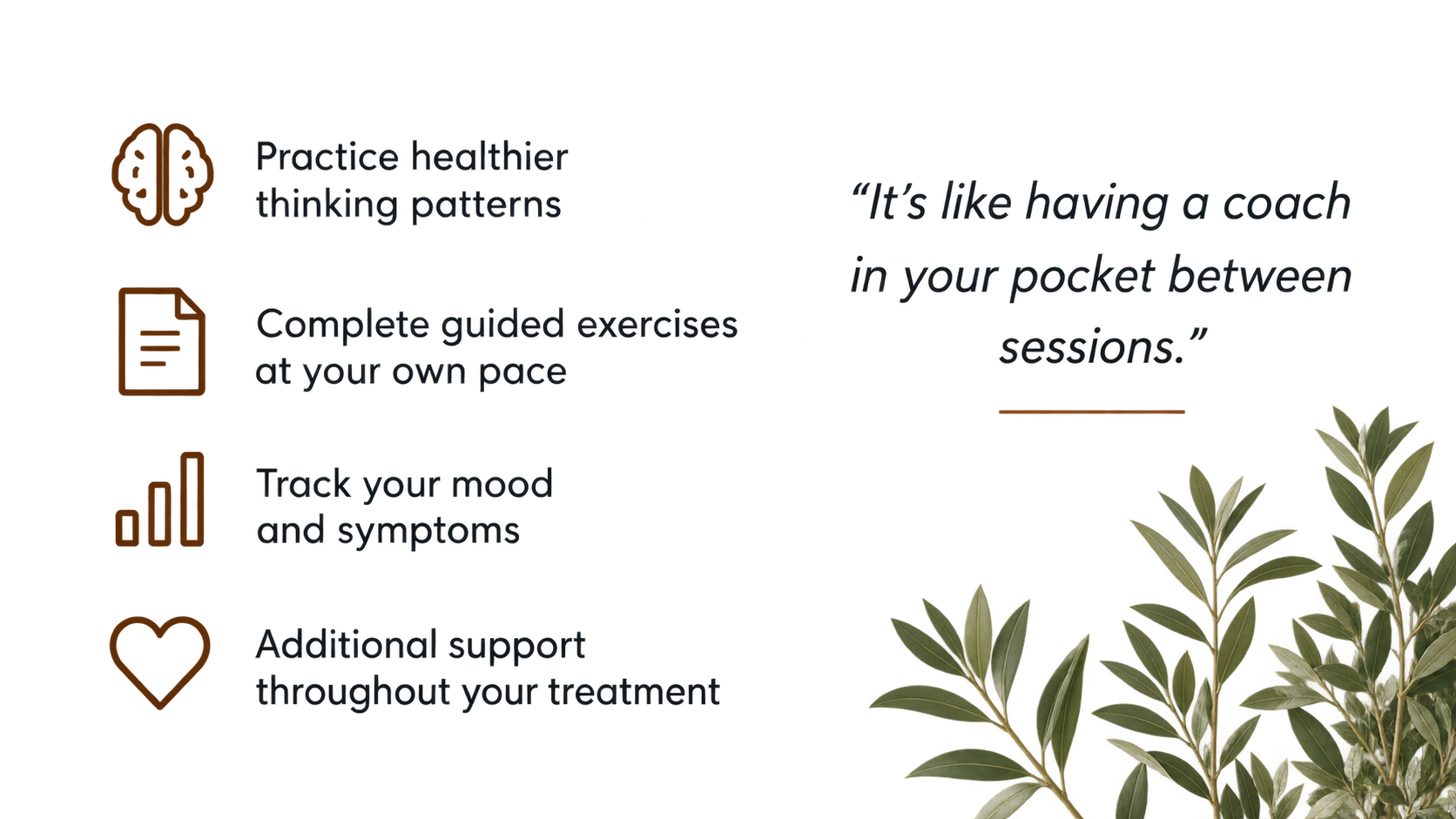
For eligible patients, optional AI-guided cognitive behavioral therapy (CBT) support is available to help reinforce your progress and keep you engaged with your care between TMS appointments.
- Practice healthier thinking patterns
- Complete guided CBT exercises at your own pace
- Learn practical coping strategies
- Track your mood and symptoms over time
Ongoing Monitoring
Dr. Stone remains involved throughout your treatment course. Our team monitors your progress, checks in on how you're feeling, and makes clinically appropriate adjustments when needed.
- We monitor your response and symptoms
- Treatment settings can be adjusted when appropriate
- We discuss questions or concerns as they arise
- We can coordinate with your existing providers
Complete Your Treatment Course
At the end of your treatment course, Dr. Stone reviews your progress with you and discusses what comes next based on your response, goals and ongoing care needs.
- Your progress and changes in symptoms
- Your ongoing treatment plan
- Whether additional TMS treatment is appropriate
- Coordination with your regular healthcare provider
AI-Guided CBT Support
(Optional, for Eligible Patients)
SUPPORT BETWEEN SESSIONS
Healing doesn’t only happen in the clinic. Our Optional AI-guided cognitive behavioral therapy (CBT) support gives you tools to reinforce your progress between TMS Sessions.
Common Questions
-
During treatment, you’ll sit comfortably while a magnetic coil rests against your scalp. Most patients describe the stimulation as a tapping sensation and may hear clicking from the device.
You remain awake and alert throughout treatment. Some people experience temporary scalp sensitivity or discomfort, particularly during their first few sessions.
-
No. TMS and electroconvulsive therapy (ECT) are very different treatments.
TMS uses magnetic pulses to stimulate targeted areas of the brain and does not require anesthesia or intentionally produce a seizure. ECT uses an electrical current to produce a controlled seizure while the patient is under anesthesia.
TMS is performed on an outpatient basis, and most patients can return to their usual activities immediately afterward.
-
At Anew TMS, typical treatment sessions are approximately 3 minutes, depending on the protocol prescribed for you.
TMS is performed while you are awake and alert and does not require anesthesia or a recovery period.
-
Before regular treatment begins, your TMS settings are personalized to you.
Dr. Stone performs motor threshold mapping, which helps determine the appropriate treatment location and stimulation intensity. You’ll remain awake throughout the process, and the team will explain what is happening along the way.
Once your individualized settings have been established, treatment can begin according to the protocol Dr. Stone has prescribed.
-
In most cases, yes. TMS does not require anesthesia or sedation, so there is no routine recovery period.
Most patients can drive themselves to and from appointments and return to work, school, errands, or other everyday activities immediately afterward.
-
TMS is prescribed as a course of treatment rather than as a single session, and completing the recommended course gives Dr. Stone the best opportunity to evaluate your response.
Because improvement may develop gradually, feeling the same—or beginning to feel better—early in treatment does not necessarily mean treatment should be stopped. Dr. Stone will monitor your progress and discuss any changes to your treatment plan with you.
-
No. AI-guided CBT is designed to supplement your care, not replace it.
Your TMS treatment remains directed by Dr. Stone and supported by the Anew TMS team. The AI tool provides optional education, coaching, and structured CBT exercises you can use between appointments and at your own pace.
-
TMS and Cognitive Behavioral Therapy support patients in different ways. TMS uses targeted magnetic stimulation to activate areas of the brain involved in mood regulation, while CBT helps you identify unhelpful thought patterns and practice healthier ways of responding to everyday challenges.
Offering CBT-based support alongside TMS gives eligible patients practical tools they can use between sessions and continue applying beyond their treatment course.
-
AI-guided CBT is completely optional.
It is available as an additional resource for eligible patients who would like structured support between TMS appointments. Choosing not to use it does not affect your TMS treatment.
For eligible patients, AI-guided CBT support is available as part of the Anew TMS treatment experience.
Our team can explain whether it is available with your treatment plan and answer any questions about how the tool works before you choose to use it.

Treatment That Fits Into Your Life
TMS is an outpatient treatment with no anesthesia and no recovery period.
For many patients, it becomes a short, predictable part of the day.